

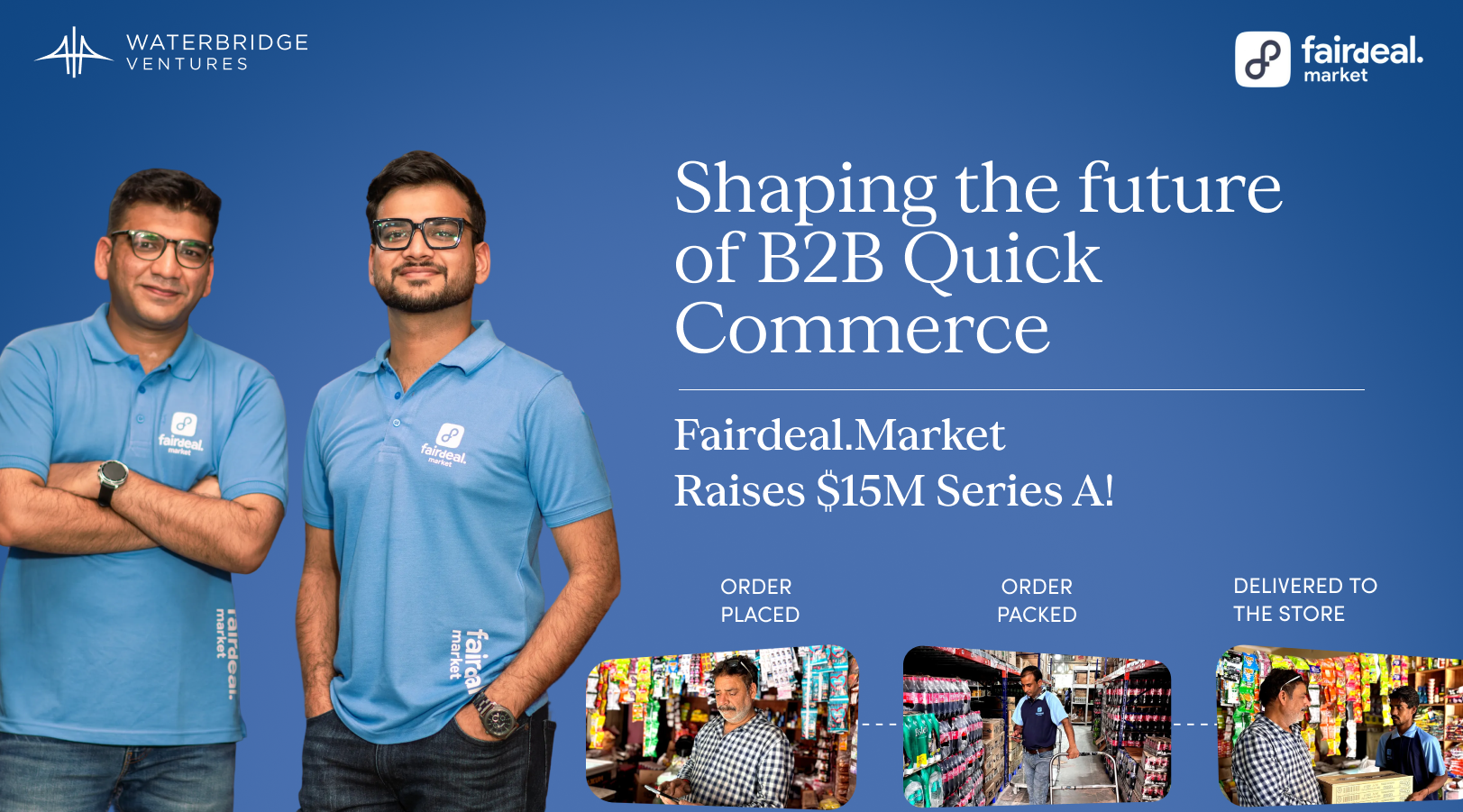


Fairdeal.market, the B2B quick-commerce platform for India’s kirana stores, has closed a $15M Series A, with WaterBridge continuing to invest as the largest institutional investor and Bertelsmann India Investments leading the round. The round lands almost exactly a year after FairDeal’s $3M pre-Series A.
The fresh capital will be deployed to scale dark store operations, strengthen the retailer network, expand last-mile delivery, and build out the tech and data stack, with an eye on new metro cities and a retailer network crossing 100K by the end of FY27.
When we led the Seed round of Fairdeal.market in 2023, it was still testing waters. As we invest for the third time, in as many years, it has set sail for deeper waters!
WaterBridge looks for large markets that are structurally broken, business models that are non-obvious, and founders whose insight is earned rather than borrowed. Rarely do all three line up.
Here they did, and that is why we backed Prateek and Yash, the siblings who founded Fairdeal.market in 2022.
The last slow mile
India has built the fastest consumer commerce on the planet. A family in Gurugram can get a packet of chips delivered in 10 minutes. But the kirana next door, which moves $640B worth of retail, waits for days for a distributor van to show up.
13M kiranas undergo this ordeal. Every stockout is a sale handed to the quick-commerce rider driving past. And every lethargic inventory item is working capital sitting on the shelves.
Balancing both is a delicate act.
Fairdeal.market built its answer to that specific problem: a network that promises 1,000+ SKUs delivered to a retailer’s doorstep at the retailer's desired frequency. In the last six months alone, it has scaled to over 20K active retailers across Delhi NCR. That kind of density comes only from retailers actually reordering, week after week.
The unmodernised rails
The supply chain connecting kiranas to brands has barely changed in decades. Wherever that slows, everyone downstream is impacted. The brand that cannot grow, the retailer whose capital is stuck and income is capped, and the customer who does not find what they came for.
Scaling a broken model does not fix it. It multiplies what was broken, only faster and more expensively. While solving for supply chain in India, the answers are never obvious. What makes sense on paper breaks on the ground. The problem is shared; the solutions are many; those who survive are the ones with a strong contact with reality.
After a few initial experiments, Fairdeal.market chose to start with solving the hardest part of the equation: building demand-side loyalty, because that is where trust is won or lost. The thesis was to prove that a low-cost and durable demand engine can be built if real value is imparted to the retailers. And once this demand engine is in place, a strong value for brands will emerge.
Replenishment is the problem, not ordering
A retail shop of a few hundred square feet in size has no adequate storage to accommodate bulk inventory. Neither does it have the working capital to fund that purchase. It needs small quantities, continuously, quickly.
The key for Fairdeal.market was to truly understand this pain that a kirana feels every single day — the broken procurement run, the locked working capital and shelf space and lack of access to the more profitable assortments. Fairdeal.market custom-built its offering to solve for this one thing: replenishment.
Faster delivery multiple times a day, and the underlying data moat
The solution resonated so deeply with the retailers that 80% of those acquired stayed, with no credit and no discounts holding them there.
This let Fairdeal.market demonstrate that a dark store can become profitable on a base of just 3,000–4,000 retailers. Low CAC and high LTV as a starting position made the unit economics real. And once that is true, the infrastructure, the technology and the playbook become a moat rather than a cost.
As Fairdeal.market expands, replicates this discipline across new geographies and dark stores, and builds scale, it can become a meaningful platform for brands too. Brands of all sizes, whether dominant, regional, or D2C, have always found offline distribution capital-intensive, slow, and data-dark.
At scale, Fairdeal.market can offer brands a data-first, plug-and-play physical distribution channel. That is what is still being built, and a lot of value sits there.
It is not an empty field. Fairdeal.market competes with HomeRun and Kiko Live in B2B quick commerce, and with the older guard — Udaan, IndiaMART, Flipkart Wholesale — in the broader B2B e-commerce market. What sets FairDeal apart is not speed alone; it is the decision to build the demand engine before monetising it, and to earn a place on a kirana’s shelf rather than rent one.
The 4 pillars holding Fairdeal.market
Four things, in our view, hold this up: discipline in what to build first, a real understanding of the customer’s daily pain, a focus on delivering value before extracting it, and the execution to keep both promises — to the retailer and to the brand — at the same time.
Fairdeal.market has laid the foundation and is building these pillars now. On them will stand whatever it becomes. It is the beginning of the next phase, and a great deal of execution lies ahead.
But the instinct that brought Fairdeal.market here — solve before you scale — is the core value for a young company to carry forward.
Way Forward
Our one hope for this round is that more capital will sharpen this instinct and embed it further in Fairdeal.market’s DNA. This round is the validation of what has been built so far and what it can become. How the capital gets deployed and what it unlocks will set the future direction from here.
Congratulations to Prateek, Yash, and the incredible Fairdeal.market team on their well-deserved Series A! A warm welcome to Bertelsmann India Investments to join us on the cap table, and to Incubate Fund and everyone for their continued support.